
Loans of over Rs 1.8 trillion, for which agreement has been signed by banks, are likely to be referred to IBC.

In the past two months alone, four companies have garnered a cumulative Rs 22,400 crore via this route.

The operating environment is unpredictable, but if the bank can't give a clear picture of what's in store, calling the bottoming out of its asset quality stress is nearly impossible.

A recent report by Citi had pegged the total amount stuck in stalled projects across seven major Indian cities (Bengaluru, Mumbai Metropolitan region, National Capital Region, Ahmedabad, Hyderabad, Kolkata and Pune) at Rs 80,000 crore.

'The announcement has come too late. This should have been done years ago.'

It has been a decade since Shyam Srinivasan took over as managing director and chief executive officer at Federal Bank. He wants to ramp up the bank's unsecured lending going ahead even as it homes into the space vacated by competition. Reappointed for a fresh three-year term as the bank's helmsman, he spoke to Hamsini Karthik on the plot ahead.

Out of 11 companies that got listed in 2019, nine have outrun the market by gaining more than 10 per cent against their respective issue price.

Sources say given the complexity involved in the process of creating a holding company, which will ultimately be the parent company of banking and other businesses, banks are going slow in acquiring stakes in insurance arms or mutual funds of other lenders.

Despite the 3 per cent gain in September 2019, the FPI sell-off during the quarter has seen the benchmark indices - the S&P BSE Sensex and the Nifty 50 register negative returns in Q3CY19.

So far in September, the S&P BSE Small-cap index has gained nearly 3 per cent as compared to a modest 0.2 per cent dip in the S&P BSE Sensex.

Being one of the early commentators to flag economic slowdown and caution investors on corporate earnings, Gautam Chhaochharia, head of India research, UBS Securities, in an interview with Hamsini Karthik says the markets remain in an expensive zone despite the recent correction.

Given the relevance of bank deposits for Indian savers, whether the regulator would permit linking savings interest rate to a repo-like structure needs to be seen, as a move of this nature could increase volatility in savings also.
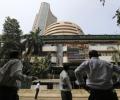
After turning net buyers for the fifth straight month till June, foreign portfolio investors (FPIs) withdrew a net of Rs 11,743 crore ($1.7 billion) in July. This was their highest outflow since October 2018.

Over the past one-and-half years, the number of stocks trading below their respective face value has increased 29 per cent after a sharp correction in stocks of small-cap companies.

Unlike in the past, when old private banks compromised upon underwriting standards to take on the bulk, they've now realised that scaling up at the cost of quality isn't worth the while. These banks have also readjusted growth targets when required, and rebalanced books to preserve capital and asset quality.

An analysis of past 20 years' demand cycles done by Edelweiss Securities indicates that the auto sector is currently in the middle of a down cycle. Volume recovery, they say, is unlikely to be as sharp as in the past, unless there is strong fiscal support.
The proposal to increase public float, hike income tax surcharge, move to tax share buybacks and lack of stimulus to shore up economic growth has hurt investor sentiment.
Prices in Bengaluru, the National Capital Region, Hyderabad and Ahmedabad, however, witnessed an uptick during the period.

Liquidity issues post the crisis at DHFL, progress of monsoon, rupee trajectory at the domestic level and oil prices are some factors that will keep markets choppy, analysts say.

The liquidity crisis at Dewan Housing Finance Corporation Limited (DHFL) has dented the fortunes of ace investor Rakesh Jhunjhunwala, who increased his stake in the troubled company in the March 2019 quarter (Q4FY19).
 © 2026 Rediff.com - Investor Information - Advertise with us - Disclaimer - Privacy Policy - Sitemap - Feedback - About us - Terms of use - Grievances